
Good Condition Monitoring always delivers!
Sappi is the world market leader in paper and pulp manufacturing. One of their 15 factories is located in Lanaken Belgium; about 6 kilometers from Maastricht. Since 1988, people have been working on condition monitoring here, which means that one can rightly speak of entrepreneurs in this field. Various new technologies have recently been introduced that make an extra contribution to the timely recognition of bearing and machine problems.
“In 1988 we started measuring with various data collectors and in 1991 we implemented our first Local Monitoring Unit (LMU), a 32-channel online system, which we have continued to expand,” says Patrick Landerloos, responsible for Condition Monitoring at Sappi. “We started phasing out LMUs with SKF IMx online systems in 2013 and upgraded the software to @ptitude Analyst in 2015. From 2021 we will start implementing IMx-1 wireless sensors.”

Conversion example
Continue to invest in condition monitoring
Condition Monitoring has now proven its worth for Sappi. For example, it is an essential part of keeping technical time loss (percentage of the production time that is allowed to stop unplanned for technical reasons) within the norm. In addition, condition monitoring is important for safety within the production facility. SKF has been supporting the paper manufacturer for more than 25 years and so the transition has also started to renew the outdated Condition Monitoring technologies.
The latest developments within SKF's Condition Monitoring range are the IMx-1 Wireless Sensor and the IMx-8 Online module in combination with the so-called @ptitude Observer software (as a parallel development to @ptitude Analyst).
At the end of 2020, IMx-1 Wireless Sensors were applied to five refiners of paper machine PM8. Patrick Landerloos: 'This gives us a much higher data density because we can take measurements per day or per hour. In addition, we can collect data from places that are difficult or impossible to access. That in itself already ensures safer working, but we also reduce man-hours because we collect even more automated data instead of manually. By automating the walking routes, analysis specialists can spend their time interpreting the data. The alarms from the online systems are analyzed daily, offline measurements are taken and analyzed every four weeks.”
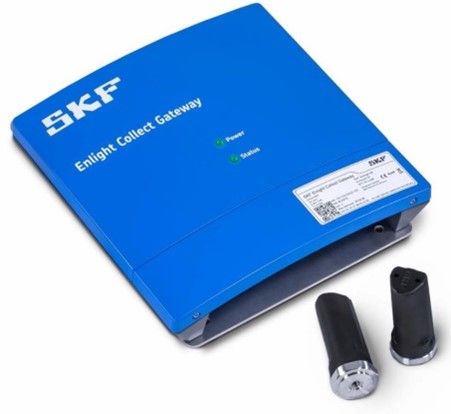
IMx-1 Wireless Sensor
Substantial savings
The condition monitoring program detects early bearing damage with a scoring chance of at least 97% and thus makes a substantial contribution to obtaining optimum technical machine availability.
As a result, about 90 large bearings can be replaced annually as a preventive measure, of which 20 to 30 bearings are overhauled. That saves at least 35% in costs compared to having to buy new bearings.
“We do the vibration analyzes ourselves and therefore detect the problems ourselves,” Patrick Landerloos continues. SKF application engineers visit us regularly and then inspect the removed bearings of the detected cases, which we replace and keep separate. These inspections result in proposals for improvement, an example of which is Paper Machine PM7 wet end, where complete bearing housings (Timken bearings) have been replaced by SKF bearing housings and SKF bearings. Here we had frequent bearing damage as a result of water penetration into the bearings'.
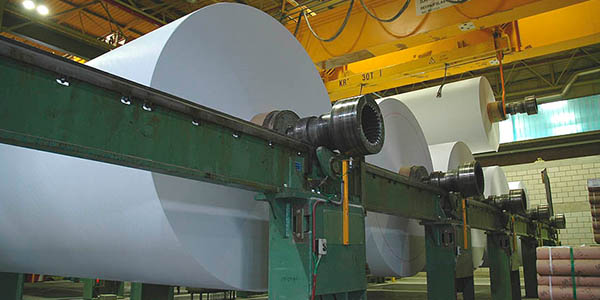
Sappi Lanaken paper machine 8 finished product
Sappi
Sappi's 12,500 employees worldwide produce about 6.5 million tons of paper, 3 million tons of paper pulp and 800,000 tons of chemical cellulose per year. Sappi also managers 567,000 hectares of sustainable forestry in South Africa, where they also have 5 factories. In North America we find 4 factories; in Europe 10.
Sappi Lanaken Mill, located along the Albert Canal in northeastern Belgium, is an integrated mill that produces chemical, thermal and mechanical pulp (CTMP) based on waste wood from sawmills and prunings from sustainable forest management.
The production site covers 35 hectares and provides employment for 600 employees. About 490,000 tons of paper and 190,000 tons of pulp are produced.

Sappi Lanaken
Talk to us about Automating predictive maintenance for reliable rotation
